
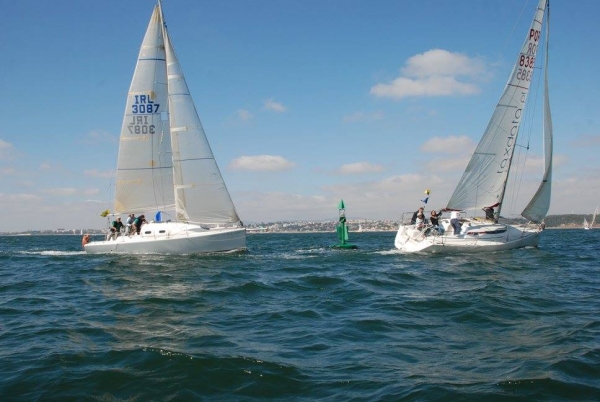
Being a yacht sailor for many years, a bit more then my working years, i learn the importance of leaders and their importance in rough seas.
A competitive sailboat depends on people and interdependence, yet sailboats are what one might consider on the business world as “top-down management”, with high hierarchy, very specific roles and different levels of responsibility.
But there´s a twist…
Leaders “on your boat” are there to protect you, not themselves.
A successful regatta sailboat cannot lack the ability to benefit from the knowledge and experience of all members, because we know that knowledge, experience and spot on crew work are an important part on winning regattas, while being safe.
Yet… a successful crew must have leaders, formal and informal. These are typically found within skippers, helmsman’s, tacticians and the most experienced crew members, but they don’t manage, they lead by example.
Again, there´s an important twist…
On a crew there´s true interdependence. Leaders serve the crew so that the crew can serve back by doing their jobs well, not on an average way. Average does not win regattas. Performing their jobs well while felling safe in an non-controlled environment is key to top performance both on the water and in your office. On the water safe sometimes mean back in one piece to port.
So… let´s say you are working in a company shareholder profit driven…
Shareholder-driven organisations came in many flavours, in the public sector the “share” is replaced by “short-term politics” and external influence. In either case… leaders and middle management will do whatever then can to save their skin, to serve shareholders and stock profit. In these environments, there is such a ditch between leadership, employees and their customers that on the long run profits will hurt and shareholder profit goes down the drain.
The popular tradition of the sea – “The captain goes down with the ship” doesn’t apply here.
What about the employees… the crew
Employees who on a daily basis deal with costumers and consumers, feeling unsafe, will try to protect themselves the best they can. It becomes A or THE daily task, and by doing so you get an organization that´s trying to survive, to protect itself from itself.
These environments provide little or no room to innovation or even to perform. The whole organization loses its drive to do what is supposed to do – Add value to their products and services. Instead you get a circle of unsafety, a top-down cortisol-driven organization.
Crews are “family”, they stick together in rough seas and when things don’t go as expected, you don´t throw a crew overboard. You wouldn’t do that to family would you?


Leave A Comment